×

The Standard e-Paper
Home To Bold Columnists
 The Standard Group Plc is a
multi-media organization with investments in media platforms spanning newspaper
print operations, television, radio broadcasting, digital and online services. The
Standard Group is recognized as a leading multi-media house in Kenya with a key
influence in matters of national and international interest.

Audio By Vocalize
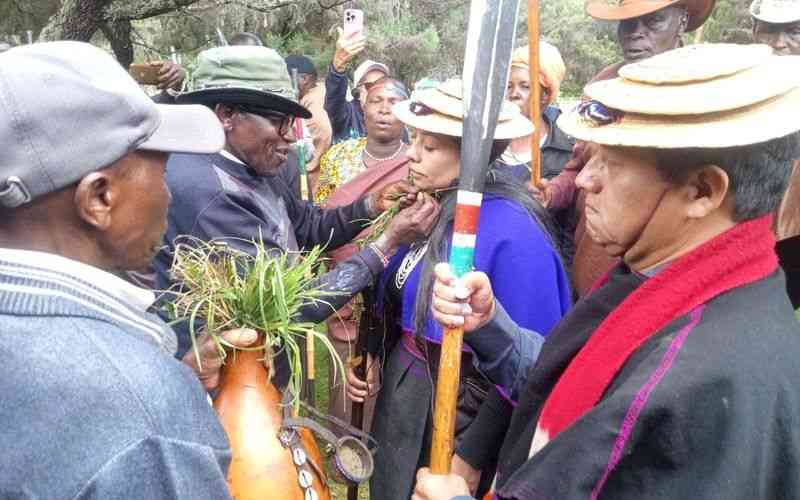
In Laboot village on Mt Elgon’s Chepkitale moorland, elders, youth and visitors gather to discuss the community’s future.
Among them are six members of Colombia’s Misak community, who have travelled about 12,000km to share their experience of defending ancestral land.
At 3,000m, the Ogiek are rebuilding without cement or grand ceremonies. Their homes are huts roofed with heather thatch (kuserwo).
For 77-year-old Johnson Takur, the gathering revives memories passed down by his late father. In 1974, a forest officer declared the family illegal occupants on their own land. “The forest was not a forest. It was our farm, church, pharmacy and school. Then they made it a game reserve, then a national park, then a forest reserve. Each time, we became smaller,” Takur said in Ogiek, translated by Teresa Cheptuit.
The Ogiek, Mt Elgon’s original inhabitants, endured numerous evictions from 1932 to 2006. They were displaced by the Sabaot Land Defence Force conflict and suffered abuses during Operation Okoa Maisha. Some were resettled in Chebyuk as squatters.
A landmark ruling offered a turning point. On September 27, 2022, the Environment and Land Court in Bungoma declared the 80,000-acre Chepkitale area community trust land belonging to the Ogiek.
Returning was not easy. Peter Kitelo, executive director of the Chepkitale Indigenous Peoples Development Project (CIPDP), said families walked back despite having little money. “We had won the case, but we had no money to return. People just started walking. Women carrying sufurias, older men carrying beehives. They said: if it is our land, we will die there.”
The community found its sacred cave at Lolwoot intact, with elephants present. Elders, women and youth, supported by CIPDP, developed bylaws documented by the Chepkitale Ogiek Governing Council to safeguard ancestral resources.
The rules prohibit charcoal burning, commercial farming and tree felling. They protect beekeeping, clan ownership of honey trees and elephant corridors. They also bar child marriage and ensure women control honey income.
On October 21, the Ogiek began developing a 50-year community strategic plan (the Life Plan).
Six Misak visitors shared parallels with their struggle. Lilian Muelas and Jeremias Ullune said Colombia had sought to declare their ancestral paramo a national park without consent, but the community challenged the move.
The Misak developed their Life Plan, nu nachak, in 1998.
Supported by Nia Tero, the initiative aims to produce the Ogiek’s first long-term, community-led development vision, grounded in customary values.
Kitelo said it would guide self-determination, cultural resilience and environmental protection. Priorities include preserving traditional governance, mapping sacred sites and honey trees, and reviving the Ogiek language through community radio.
The plan will promote indigenous cattle, beekeeping and wild berry collection, while addressing land-title management, boundary disputes and engagement with county authorities.
Stay informed. Subscribe to our newsletter
Takur, chair of Ogiek Council of Elders, said the plan could shield land registration from political interference. “Chepkitale is not idle land for resettlement schemes. It is a community-conserved area that feeds elephants, feeds us, and stores water for Bungoma and Trans Nzoia counties.”
Elder Cosmas Murunga said the process was key to the community’s survival. The Life Plan is expected to be completed by end of the year, ready for implementation.







Subscribe to our newsletter and stay updated on the latest developments and special offers!